VISAGEFIT · DAY 4 OF 5
The Mandible: Why Your Lower Jaw Matters for Your Jawline
Yesterday, we explored horizontal and vertical facial development. Today, let's look at one of the most important structures shaping your lower face: the mandible.
Meet the Mandible
The mandible is your lower jawbone. It shapes the chin, jawline and lower facial contour, and provides attachment points for the muscles involved in chewing and moving the jaw.
When you look at a defined jawline, you're not just seeing skin and muscles. You're seeing the relationship between the underlying bone, the soft tissues around it, and the position of the head and neck.
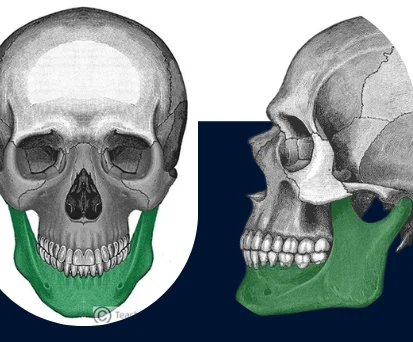
That's why, in my approach to natural facial rejuvenation, I don't look at the jawline as an isolated area.
The Silent Changes in the Lower Face
Our facial skeleton continues remodeling throughout life, including the mandible. The lower jaw also responds to dental health, tooth loss and changes in the surrounding tissues.
With time, you may notice changes in jawline definition, the chin area, jowls and the contour beneath the lower jaw. The bone is only one part of this picture: skin, fat pads, muscles, fascia and posture also influence what you see in the mirror.
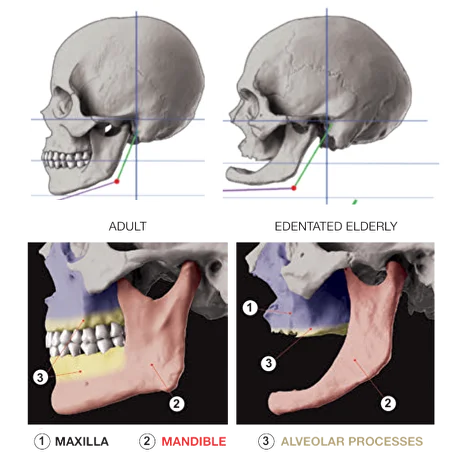
One important detail: illustrations comparing a dentate adult jaw with a toothless older jaw show changes associated with tooth loss as well as aging. They shouldn't be interpreted as what happens to every jaw with age.
Why I Work Beyond the Jawline
The mandible is closely connected to the chewing muscles, the temporomandibular joints, the tongue, the hyoid region and the neck.
Think about how often you clench your jaw, press your teeth together, tilt your head forward or hold tension in your neck and shoulders. These habits can influence the way the lower face feels and appears.
And if muscular and fascial imbalances are left unaddressed—not only in the face, but throughout the body—they may contribute to very visible facial asymmetry.
This is why I pay attention to the full picture:
- Jaw and chewing muscles: their activity, coordination and tension.
- Fascia: how tension is distributed across the face, scalp and neck.
- Posture: especially the position of the head, neck and shoulders.
- Daily habits: tongue posture, nasal breathing when comfortable, and unnecessary jaw clenching.
What Helped Accelerate My Own Results?
When I started working with facial muscles and skincare, I already noticed improvements. But I wanted to go further, especially with my jawline and lower-face definition.
In my own case, I placed particular emphasis on mandible traction and working with the facial and cranial sutures.
Adding these techniques was part of the period when I noticed my visible results accelerating—especially in my jawline definition and overall facial balance.
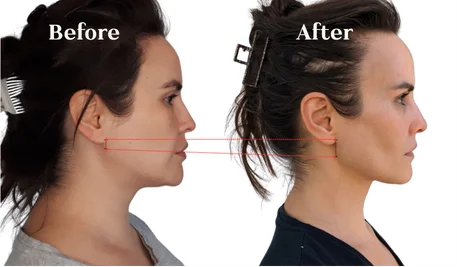
For me, it wasn't about adding more random techniques. It was about understanding where to focus my efforts.
What Can You Start Paying Attention to Today?
Notice your jaw at rest. Try not to hold your teeth clenched together throughout the day.
Check your tongue posture. Let the tongue rest lightly against the upper palate without pushing on the teeth.
Look beyond your face. Pay attention to your neck, shoulders and forward-head posture, especially after long periods at a desk or on your phone.
Be gentle. Don't force the jaw or work through sharp pain. If you have persistent jaw pain, locking or a diagnosed jaw condition, consult a qualified clinician before trying manual techniques.
Coming Up in Day 5: Putting It All Together
We've explored bone resorption, the maxilla, facial development and now the mandible. But how do you bring all of this together in practice?
Tomorrow, I'll share what I personally include in my facial rejuvenation routine, how I combine different techniques, and why the order matters.
I'll also show you the cheat sheet I created for myself after mastering all these techniques, so I could follow my routine without having to remember every single step.
See you in Day 5!
Practical Part: Relax Your Chewing Muscles
Try these two gentle releases following the instructions below. The masseter and temporalis help close and position your jaw. Releasing excess tension may help your jaw feel less compressed and allow it to settle into a more relaxed position, which can make the mandibular angle look more defined. These exercises do not physically pull the jawbone outward.
Your mandible doesn't work on its own. Two important chewing muscles are the masseter and temporalis. When these muscles are overly tight, they can contribute to jaw tension and affect how your lower face feels and looks. That's why I include gentle relaxation in my jawline practice.
1. Masseter release
Focus on the two attachment areas as marked on the picture: the upper attachment near the cheekbone and the lower attachment along the mandible. Apply gentle, steady pressure to each point for 30 seconds. Keep your jaw relaxed and avoid pressing hard.
2. Temporalis release
Open your mouth slightly to help relax the muscle. Place your fingertips on your temples and gently massage upward, following the muscle toward the top of your head. Repeat 10 times.
Remember: it's not just about strengthening facial muscles. It's also about understanding which areas need to relax. If you already have my 17-Course Bundle, you'll find more detailed techniques in your course library.
Lilya from VisageFit ❤️